
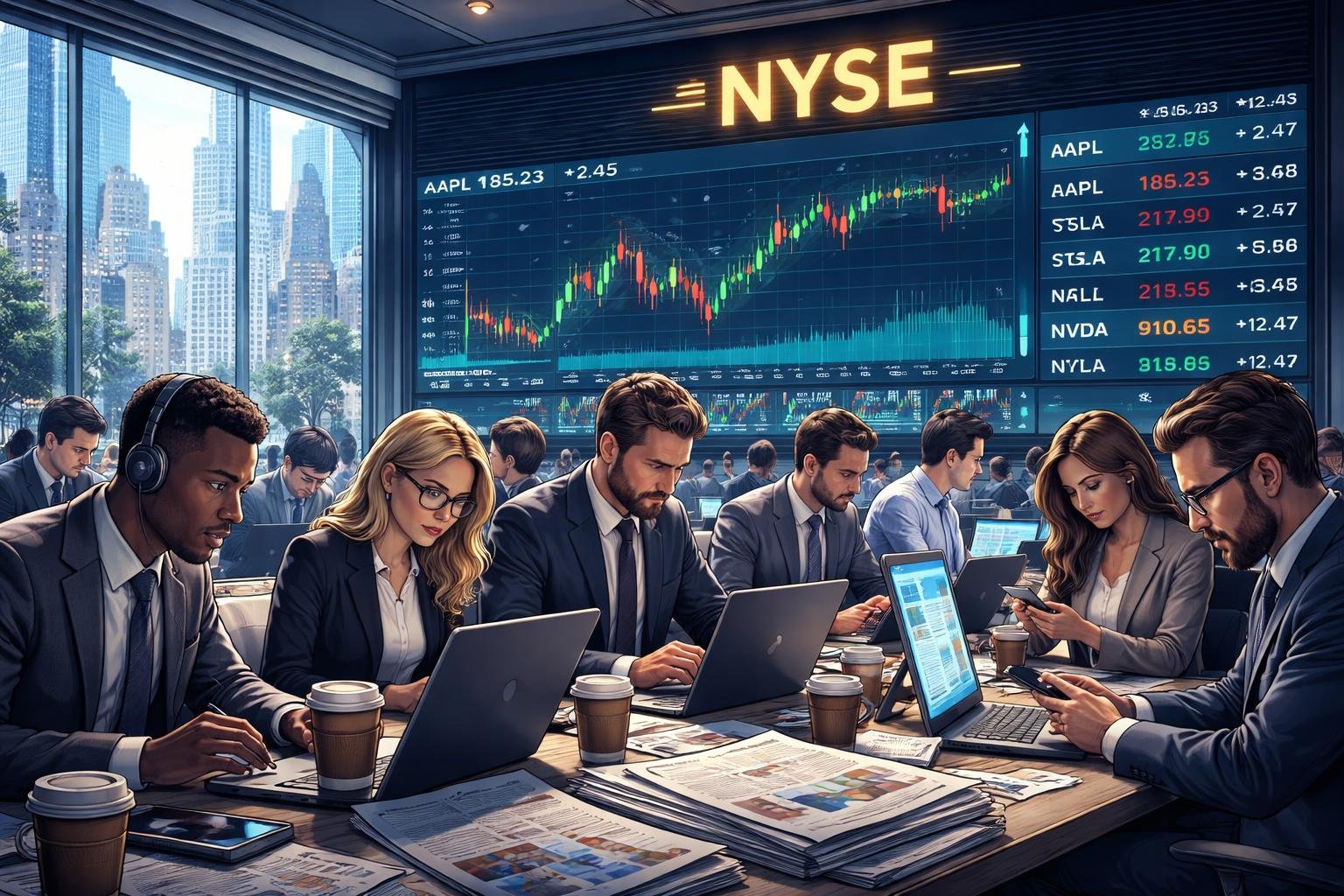
The financial markets are experiencing a seismic shift. What was once the exclusive domain of Wall Street hedge funds and institutional traders is rapidly becoming accessible to everyday investors. At the center of this transformation is artificial intelligence—specifically, AI-powered trading platforms like Blustar AI stock systems that are fundamentally changing how retail investors approach the markets.
But is this just another tech fad, or are we witnessing the genuine future of retail investment? Let’s explore the forces driving this revolution and what it means for your financial future.
The Retail Trading Crisis: Why Traditional Approaches Are Failing
The statistics are sobering. Research consistently shows that approximately 90% of retail traders fail to generate consistent profits. That’s not a typo—nine out of ten individuals who attempt to trade stocks, forex, or cryptocurrencies end up losing money over time.
The reasons for this failure rate are complex but well-documented:
Emotional Decision-Making: Fear and greed drive poor timing decisions. Investors buy at market peaks driven by FOMO (fear of missing out) and sell at bottoms out of panic. Studies indicate that roughly 70% of trading losses stem directly from emotionally-driven decisions rather than flawed strategies.
Time Constraints: Successful manual trading demands constant market monitoring. The average active trader spends over 8 hours daily analyzing charts, reading news, and executing trades. For people with full-time jobs or family commitments, this level of dedication simply isn’t realistic.
Information Overload: The sheer volume of market data, news events, and technical indicators creates analysis paralysis. By the time a human trader processes information and makes a decision, market conditions have often already shifted.
Lack of Consistency: Human traders struggle to execute their strategies with machine-like precision. Fatigue, distractions, and changing emotional states lead to inconsistent application of even well-designed trading plans.
These challenges have created a crisis of confidence in traditional retail trading approaches—and opened the door for technological solutions.
The Emergence of AI in Financial Markets
Artificial intelligence isn’t new to finance. Institutional investors, hedge funds, and proprietary trading firms have employed algorithmic trading systems for decades. What’s changed is the accessibility of this technology.
The AI trading platform market tells a compelling growth story. Industry analysts project that the global market for AI-powered trading solutions will reach nearly $70 billion by 2034, representing explosive growth from current levels. This expansion is being driven by several converging trends:
Democratization of Technology: Cloud computing and API-based trading infrastructure have dramatically reduced the barriers to entry for AI trading platforms. Solutions that would have required millions in development costs a decade ago can now be built and deployed at a fraction of that investment.
Advances in Machine Learning: Modern AI systems can identify complex patterns in market data that human traders simply cannot perceive. These systems process millions of data points per second, detecting correlations and opportunities across multiple markets simultaneously.
Regulatory Evolution: Financial regulators have gradually adapted frameworks to accommodate algorithmic trading for retail investors, creating clearer pathways for platforms like Blustar AI stock solutions to operate compliantly.
Shifting Investor Expectations: A new generation of investors, comfortable with technology and automation in every aspect of their lives, naturally gravitates toward automated investment solutions. They expect their money to work as intelligently as their smartphones.
How Automated Trading Systems Are Different
Blustar AI stock trading platforms and similar automated systems represent a fundamentally different approach to market participation. Rather than relying on human judgment, discipline, and emotion management, these systems leverage computational power and statistical analysis.
The Core Advantages of Automation
24/7 Market Monitoring: Unlike human traders who need sleep, automated systems operate continuously. For markets that trade around the clock—like cryptocurrencies and forex—this means never missing an opportunity due to inconvenient timing.
Emotion-Free Execution: Perhaps the single greatest advantage of automated systems is their complete indifference to fear and greed. A Blustar AI stock trading bot executes its programmed strategy with perfect consistency, unaffected by market panic or euphoria.
Speed and Precision: Automated systems can analyze market conditions and execute trades in milliseconds. When opportunities arise—or when risk management protocols are triggered—there’s no delay between decision and action.
Backtesting and Optimization: Before risking real capital, automated strategies can be tested against years of historical market data. This allows for refinement and optimization that would be impossible with manual trading approaches.
Diversification at Scale: A single automated platform can simultaneously monitor and trade across multiple markets, asset classes, and strategies. Blustar AI stock systems, for example, can operate gold, Bitcoin, and forex strategies concurrently—something few individual traders could manage manually.
The Limitations Worth Understanding
Honesty requires acknowledging that automated trading isn’t a magic solution to all investment challenges. These systems operate within certain constraints:
Market Condition Dependency: AI trading systems are designed for specific market conditions. Strategies optimized for trending markets may struggle in ranging conditions, and vice versa. The best platforms, including Blustar AI stock solutions, employ multiple strategies to adapt to changing conditions.
Technology Risks: Any system relying on technology faces risks from connectivity issues, software bugs, or platform outages. Reputable providers implement redundancies and safeguards, but these risks cannot be eliminated entirely.
No Guarantees: Despite their sophistication, no automated system can guarantee profits. Markets are inherently uncertain, and even the most advanced AI cannot predict every movement or external shock.
Learning Curve: While platforms like Blustar AI stock trading systems are designed for ease of use, investors still need to understand basic concepts around risk management, position sizing, and performance evaluation.
Why Retail Investors Are Making the Switch
The migration from manual to automated trading isn’t happening in a vacuum. Real investors with real capital are choosing platforms like Blustar AI stock systems for tangible reasons:
Time Liberation
For professionals, business owners, and busy parents, the ability to participate in financial markets without constant monitoring is transformative. Automated systems handle the heavy lifting—data analysis, trade execution, position management—while users maintain their regular lives.
Emotional Peace of Mind
Many traders report that the psychological burden of manual trading is as exhausting as the time commitment. Constantly second-guessing decisions, experiencing regret over missed opportunities, or losing sleep over open positions creates genuine stress. Automation removes this emotional weight.
Access to Sophisticated Strategies
Strategies that would require years of study and practice to execute manually—like statistical arbitrage, momentum trading, or mean reversion—can be deployed immediately through Blustar AI stock platforms. This levels the playing field between retail and institutional participants.
Transparency and Control
Modern automated platforms provide real-time dashboards showing every trade, every metric, and every performance indicator. Users of Blustar AI stock systems maintain complete visibility into their account while the automation handles execution. The capital remains in the user’s brokerage account, with full withdrawal rights at any time.
The Broader Fintech Revolution
Automated trading platforms exist within a larger fintech transformation that’s reshaping every aspect of financial services:
Robo-Advisors: Automated portfolio management services manage over $1 trillion in assets globally, bringing institutional-grade diversification to retail investors.
Payment Innovation: Digital wallets, cryptocurrency, and instant settlement are replacing traditional banking infrastructure.
Decentralized Finance: Blockchain-based financial services operate without traditional intermediaries, further democratizing access.
AI-Powered Analysis: From credit scoring to fraud detection to investment research, artificial intelligence is permeating financial decision-making at every level.
Blustar AI stock trading platforms represent the natural evolution of this trend into active market participation. Where robo-advisors handle long-term passive investing, AI trading systems address active market opportunities across multiple asset classes.
What This Means for Traditional Financial Services
The rise of automated trading creates both challenges and opportunities for traditional financial institutions:
Brokerage Evolution: Traditional brokers are adapting by offering API access and developing their own automated solutions to retain clients who might otherwise migrate to platforms like Blustar AI stock systems.
Advisory Services Redefined: Financial advisors increasingly focus on comprehensive planning, tax optimization, and behavioral coaching rather than simple investment selection and trade execution.
Education Imperative: As automation becomes more prevalent, investor education becomes more important, not less. Understanding how these systems work, their limitations, and proper risk management remains essential.
The Investment Landscape in 2025 and Beyond
Looking forward, several trends seem likely to accelerate:
Increased Adoption: As more investors experience the benefits of automation and share their results, adoption will continue expanding beyond early adopters into the mainstream.
Regulatory Maturation: Expect more sophisticated regulatory frameworks specifically designed for AI trading platforms, providing both consumer protection and operational clarity.
Technology Advancement: Machine learning models will continue improving, incorporating more data sources, and adapting more quickly to changing market conditions.
Hybrid Approaches: The future likely includes both purely automated strategies and human-AI collaboration, where traders use automated systems to handle execution while maintaining strategic oversight.
Market Efficiency Evolution: As more participants use AI systems, markets may become more efficient in some dimensions while creating new opportunities in others.
Is Automated Trading Right for You?
The question isn’t whether automated trading will become more prevalent—that trajectory seems clear. The question for individual investors is whether it aligns with their specific circumstances and goals.
Blustar AI stock trading platforms and similar systems make the most sense for investors who:
- Lack the time to monitor markets actively throughout the trading day
- Recognize they make emotionally-driven decisions that hurt their returns
- Want to participate in markets beyond traditional stock investing (forex, crypto, commodities)
- Value consistency and systematic approaches over discretionary judgment
- Seek to leverage strategies that would be difficult to execute manually
- Want transparency and control while delegating execution to automation
Conversely, investors might prefer traditional approaches if they:
- Enjoy the process of market analysis and trading as a hobby
- Have the time and discipline to execute manual strategies consistently
- Prefer complete discretionary control over every trading decision
- Are uncomfortable with technology-driven investment approaches
- Focus exclusively on long-term buy-and-hold investing
The Due Diligence Imperative
If automated trading aligns with your investment goals, proper due diligence is essential before committing capital:
Understand the Approach: Even if you’re not executing trades manually, understand the general strategy being employed. Is it momentum-based? Mean-reversion? Pattern recognition? What markets does it trade?
Verify Track Record: Look for platforms with verifiable performance history. Blustar AI stock systems should provide transparent access to historical results and ongoing performance metrics.
Assess Risk Management: How does the platform protect capital during adverse conditions? What are maximum drawdown levels? How quickly are losing positions cut?
Evaluate Support and Education: Quality platforms invest in customer support and investor education. You should have access to resources that help you understand what’s happening with your capital.
Review Terms and Costs: Understand the fee structure, any lock-up periods, withdrawal policies, and who maintains custody of your assets.
Start Conservatively: Even with confidence in a platform, beginning with a modest allocation allows you to evaluate performance and become comfortable with the system before scaling up.
The Bottom Line: Evolution, Not Revolution
Is automated trading the future of retail investment? The evidence suggests it will certainly be a major component of that future, though not necessarily the only component.
Platforms like Blustar AI stock systems represent an evolution in how technology empowers individual investors. They address real problems—emotional decision-making, time constraints, complexity—with practical solutions grounded in artificial intelligence and computational power.
The $70 billion market projection, the migration of institutional strategies to retail platforms, and the improving accessibility of these technologies all point toward continued growth and adoption.
However, automation doesn’t eliminate the need for investor education, risk awareness, or realistic expectations. These systems are tools—powerful tools, but tools nonetheless. Success still requires understanding, proper capital allocation, and alignment with your broader financial goals.
The retail investment landscape of the future will likely include traditional buy-and-hold strategies, active manual trading for those with the time and skill, robo-advisory services for passive portfolio management, and AI-powered platforms like Blustar AI stock systems for active automated trading.
The winners in this evolving landscape will be investors who thoughtfully match the right tools to their specific circumstances rather than reflexively adhering to outdated approaches or uncritically embracing every innovation.
In that context, automated trading isn’t so much the future of retail investment as it is an increasingly important option within the future of retail investment—one that solves real problems for real investors and deserves serious consideration from anyone seeking to build wealth through market participation.
The question is no longer whether AI will play a role in your investment strategy, but rather how you’ll choose to leverage it.
Ready to explore how automated trading could fit into your investment strategy? Learn more about Blustar AI stock trading solutions and discover whether AI-powered automation aligns with your financial goals.
Disclaimer: Trading involves substantial risk of loss. Past performance does not guarantee future results. This article is for informational purposes only and does not constitute financial advice. Consult with a qualified financial advisor before making investment decisions.